 shoemoney
764d7d9a16 Push always treated the local .devignore/secret-guard-filtered manifest as the FULL shared head, even on a whole-share mount — so a device with its own --exclude for a path silently deleted that path from every other device's copy on their next pull. splice() now merges local entries over the parent head instead of the parent head being consulted only for sub-path mounts: a parent-head path missing from the local manifest is carried forward when the local ignore rules are why it's invisible (excluded from view, not deleted). It is NOT carried forward when the secret guard blocked it (the guard's job is to keep that content out of the head) or when it's genuinely gone from disk with no ignore rule hiding it (a real delete must still delete). under()/strip() already treat subpath="" as "the whole path space," so this is one code path for both mount kinds, not a special case bolted onto the old one. Includes the two repro tests (deduped from a near-copy) and a new delete-case regression proving the fix didn't make real deletes un-deletable. |
||
|---|---|---|
| .forgejo/workflows | ||
| .github/workflows | ||
| cmd | ||
| deploy | ||
| docs | ||
| internal | ||
| pkg/proto | ||
| scripts | ||
| .dockerignore | ||
| .gitignore | ||
| dashboard-p3.png | ||
| docker-compose.yml | ||
| Dockerfile | ||
| go.mod | ||
| go.sum | ||
| install.ps1 | ||
| install.sh | ||
| LICENSE | ||
| plan.md | ||
| README.md | ||
📦 Continuous file sync for developers — like Dropbox, but it respects your .devignore, refuses to leak secrets, runs your hooks, and keeps Git-like history. 📦












        ╔═══════════════════════════════════════════════════════════╗
        ║   ┌─┐ ┌─┐ ┬  ┬ ┌┐ ┌─┐ ┬ ┬                                 ║
        ║   ││─┤ ├┤  │  │ ├┴┐│ │ │┴┤   sync your dev tree,           ║
        ║   ┴─┘─┘└─┘  └──┘ └─┘└─┘ ┴ ┴   skip the junk, keep history  ║
        ╚═══════════════════════════════════════════════════════════╝
Note
🎉 devbox v1 is feature-complete (M0–M7.6, fleet-verified on real hardware — Macs + arm64 Pis live-syncing through a hub on a NAS) and v2 has begun. 🔮 The v1 spec is fully implemented; the v2 spec sequences M8→M11 — M8 foundations are landing now. Star/watch and follow along. ⭐
Milestone Status M0 — Skeleton (CLI, identity, config) ✅ done M1 — Watch · .devignore· secret-guard · chunking · manifest✅ done M2 — Hub + one-way push (deployed + verified cross-machine 🛰️) ✅ done M3 — Two-way sync · SSE fan-out · 3-way conflict copies · live daemon ✅ done — two real Macs sync live through the hub 🔄 M4 — Read-only mounts · sub-path mounts · bandwidth cap ✅ done — fleet-verified M5 — Lifecycle hooks (pre/post push/pull, on-conflict) ✅ done — post-pullran on a real fleet node 🪝M6 — Versioning: log/restore+ hub GC✅ done — restore reverted a file on the fleet 🕰️ M6.5 — devbox deploy(pin a mount to a snapshot, no push)✅ done — blue/green-deployed v1 on a real box while head stayed v2 🚀 M7 — Hardening: devbox doctor, reconnect/backoff, rescan fallback, name-clash, release builds✅ done — doctor/stop/hooks + share-name guard + dead-watcher rescan fleet-verified 🛡️ M7.5 — Adversarial security/data-loss audit + fixes (path-traversal, blob integrity, never-clobber, safe GC) ✅ done — 26 findings, all promise-breakers fixed, race-clean 🔐 M7.6 — Hardening: fsync durability · DoS caps + timeouts · pidfile PID-reuse guard · join proof-of-possession ✅ done — fleet-verified on arm64 🛡️ 🔮 M8 — v2 Foundations: migration runner · per- (share,id)snapshots · control socket +pause/resume· M8a teams ·restorebyte-safety✅ justified-now scope complete & fleet-verified (Pi .13owner invited an editor, Pi.15redeemed & pushed); 3 migrations verified on a copy of the real hub DB. M9–M11 stay demand-driven 🏗️👥
📑 Table of Contents
| 🤔 Why devbox? | 🧠 Core Concepts | 🏗️ Architecture |
| 🔄 How Sync Works | 💥 Conflicts | ⚡ Install & Run |
| 🧰 CLI Reference | 📊 Live Dashboard | 🪝 Hooks |
| 🕰️ Versioning & Deploy | 🖥️ Cross-Platform | 🔐 Security & Durability |
| 🗺️ Roadmap | ⚖️ License & Open-Core | 🙌 Contributing |
🤔 Why devbox?
You've got a MacBook, a 40-node Pi cluster, and a TrueNAS box. You want your active working tree mirrored across them — right now, automatically — without committing half-done work.
Your options today all hurt:
| Tool | The pain 😖 |
|---|---|
| ☁️ Dropbox / iCloud | Syncs everything blindly — chokes on node_modules, happily uploads your .env, thrashes on build artifacts. |
| 🐙 Git | Manual. Commit-based. Not built to live-mirror an in-progress working tree. Branching ≠ syncing. |
| 📁 rsync / scp | One-shot, one-direction, no history, no hooks, no conflict safety. You babysit it. |
| 🔁 Syncthing | Great P2P sync — but no .devignore dev-ergonomics, no lifecycle hooks, no snapshot/deploy story. |
✨ devbox is the missing layer
| 🎯 | Feature |
|---|---|
| 🔄 | Continuous bidirectional sync across all your machines |
| 🙈 | .devignore (gitignore syntax) — skip node_modules, dist, the junk |
| 🔐 | Default-on secret guard — hard-refuses to upload .env, keys, secrets |
| 🪝 | Lifecycle hooks — pnpm install / restart a container when files land |
| 🕰️ | Git-like snapshots per share — roll back any file, any time |
| 🎚️ | Selective mounts — cherry-pick a share, or just one sub-path, per machine |
| 💥 | Conflict-safe — never blocks, never asks, never loses a byte |
| 🏠 | Self-hostable — one Go binary on your Pi/TrueNAS, no SaaS required |
| 🌍 | Cross-platform — Linux · macOS · Windows |
🧠 Core Concepts
mindmap
  root((📦 devbox))
    🛰️ Hub
      publishes shares
      stores chunks + manifests CAS
      brokers change events
      one owner · many devices
    💻 Device
      Ed25519 identity
      joins with a token
      runs one daemon
    📂 Share
      named tree projects/ repos/ services/
      unit of snapshot history
    🔗 Mount
      share + subpath to local path
      read-write or read-only
    📸 Snapshot
      immutable BLAKE3 manifest
      per share history
| Term | What it is |
|---|---|
| 🛰️ Hub | The server. Publishes shares, stores content-addressed chunks + manifests, brokers events. One owner, many devices. Self-hosted single binary. |
| 💻 Device | A machine with an Ed25519 identity, joined to a hub. Runs one daemon (devboxd). |
| 📂 Share | A named top-level tree on the hub (projects, repos, services). The unit of permission & history. |
| 🔗 Mount | A device-side binding: share[/subpath] → localpath, read-write or read-only. One daemon watches many. |
| 📸 Snapshot | An immutable, per-share manifest version (id = BLAKE3 of the manifest). |
🏗️ Architecture
flowchart LR
    subgraph LAP["💻 MacBook"]
        D1["devboxd 🛡️"]
        M1["📂 projects/"]
        M2["📂 repos/"]
    end

    subgraph HUB["🛰️ Hub  ·  Pi / TrueNAS"]
        WS{{"🔌 WebSocket\nchange events"}}
        HTTP{{"🌐 HTTP\nblob GET/PUT"}}
        CAS[("🧊 CAS\nchunks + manifests\nBLAKE3")]
        DB[("🗄️ SQLite WAL\nshares · snapshots\ndevices · tokens")]
        MET["📊 /metrics + status"]
    end

    subgraph PI["🍓 pi-07"]
        D2["devboxd 🛡️"]
        M3["📂 projects/p22/backend\n(read-only → /var/www)"]
    end

    M1 & M2 -->|"events"| WS
    M1 & M2 -->|"blobs"| HTTP
    WS --> CAS
    HTTP --> CAS
    CAS --- DB
    WS -->|"events"| D2
    HTTP -->|"blobs"| D2
    D2 --> M3

    classDef hub fill:#0d1117,stroke:#4F9CF9,stroke-width:2px,color:#fff;
    class HUB,WS,HTTP,CAS,DB,MET hub;
💡 Why two channels? WebSocket for live events (tiny, ordered) + stateless HTTP for blobs (
GET /blob/<hash>→ range/resume/caching for free). Same TLS endpoint, same token. Pure-WebSocket would force us to reinvent resumable transfer over a socket — more code.
🔄 How Sync Works
sequenceDiagram
    autonumber
    participant FS as 📁 Filesystem
    participant D as 🛡️ devboxd
    participant H as 🛰️ Hub
    participant P as 🍓 Peer

    FS->>D: ✏️ file changed (fsnotify, debounced ~300ms)
    D->>D: 🙈 .devignore + 🔐 secret-guard filter
    D->>D: 🧩 FastCDC chunk → BLAKE3 → manifest diff
    D->>D: 🪝 pre-push hook (can veto 🛑)
    D->>H: ⬆️ upload missing chunks (HTTP, bw-capped)
    H->>H: 📸 append snapshot, advance share HEAD
    H-->>D: ✅ ack
    D->>D: 🪝 post-push hook
    H->>P: 🔔 change event (WebSocket)
    P->>P: 🪝 pre-pull hook (can veto 🛑)
    P->>H: ⬇️ fetch missing chunks (HTTP)
    P->>P: 🧱 reassemble → ⚛️ atomic rename into place
    P->>P: 🪝 post-pull hook (pnpm install / restart 🚀)
A read-only mount skips steps 1–8 (it never pushes) but still receives and applies inbound changes. 🔒
💥 Conflicts: Never Lose a Byte
devbox is Dropbox-easy (never nags you mid-work) and data-loss-proof. Here's the magic: the hub keeps a linear HEAD per share, and every push declares the snapshot it was based on.
flowchart TD
    START([📤 push arrives]) --> Q{parent == HEAD?}
    Q -->|✅ yes| FF["⏩ fast-forward\nadvance HEAD"] --> DONE([🎉 done])
    Q -->|❌ no| THREE["🔱 per-file 3-way\nvs common ancestor"]
    THREE --> ONLY{changed by\nonly the pusher?}
    ONLY -->|yes| CLEAN["✨ applies cleanly"] --> DONE
    ONLY -->|both sides| CONF["💥 CONFLICT"]
    CONF --> KEEP["👑 first-to-land stays canonical"]
    CONF --> COPY["📝 loser saved as\nfoo.conflict-laptop-1719.go"]
    CONF --> HOOK["🔔 on-conflict hook fires"]
    KEEP & COPY & HOOK --> SAFE([🛟 zero data lost])

    style CONF fill:#5a1e1e,stroke:#ff6b6b,color:#fff
    style SAFE fill:#1e5a2e,stroke:#51cf66,color:#fff
    style DONE fill:#1e5a2e,stroke:#51cf66,color:#fff
📖 The classic "laptop was offline" scenario — click to expand
Both machines synced at snapshot S3, both have foo.go v1:
- 🔌 Laptop goes offline, edits
foo.go→ v2-laptop (queued, parent stillS3). - 🍓 Pi (online) edits the same
foo.go→ v2-pi, pushes. Hub HEADS3 → S4. Pi's wins canonical. - 🔌 Laptop reconnects, pushes with
parent=S3— but HEAD isS4.parent ≠ HEAD→ conflict path. - 🔱 Both changed
foo.gosinceS3→ real conflict. - 🛟 Result, nothing destroyed: both machines end up with
foo.go= v2-pi (canonical) andfoo.conflict-laptop-1719.go= v2-laptop beside it.
The offline edit is never lost — it just lands as a clearly-named sibling. 🎯
Conflict rules at a glance:
| Situation | Outcome |
|---|---|
| 🤝 Both edit same file | First-to-land canonical; loser → .conflict-<host>-<ts> copy |
| 🗑️ One deletes, one edits | Edit always wins — a delete has no bytes to lose |
| 🔤 Rename | Free — old-gone + new-added; content-addressed = zero re-transfer |
| 🔒 Read-only mount about to clobber a local edit | Local stashed as .conflict-local-<ts> first |
| 👀 You find out via | devbox status badge · on-conflict hook · devbox conflicts list |
🚫 No blocking prompts. A headless daemon can't prompt you, and nagging would break the whole "Dropbox-easy" promise. You get told; you choose when to look.
⚡ Install & Run
Client (macOS / Linux) — one line. Detects your platform, lets you pick where the binary lives, and offers a keep-alive auto-restart service (launchd KeepAlive on mac, systemd Restart=always on Linux):
curl -fsSL https://git.shoemoney.ai/shoemoney/devbox-dist/releases/download/latest/install.sh | sh
# non-interactive: DEVBOX_BIN_DIR=~/.local/bin DEVBOX_SERVICE=1 sh install.sh
# also install the hub: sh install.sh --hub
🪟 Windows · 🍎 macOS Full Disk Access · 🛠️ knobs
- Windows:
irm https://git.shoemoney.ai/shoemoney/devbox-dist/releases/download/latest/install.ps1 | iex— copiesdevbox.exe, adds it to PATH, and (optionally) a restart-on-failure Scheduled Task at logon. Notes Controlled Folder Access if you have it on. - From Go (have a toolchain):
go install github.com/shoemoney/devbox/cmd/devbox@latest(hub:…/cmd/devbox-hub@latest). - macOS Full Disk Access: to sync
~/Desktop,~/Documents,~/Downloads, or iCloud, grant Full Disk Access to thedevboxbinary (System Settings → Privacy & Security → Full Disk Access).devbox doctortests your actual mounts and tells you the exact fix + a deep link — a background daemon can't show the per-folder prompt, so without it those mounts silently fail. - Knobs:
--bin-dir DIR·--hub·--service/--no-service·--release-url URL(or theDEVBOX_*env equivalents). No prebuilt release? The script falls back to a localdist/(runscripts/build-release.sh) orgo build. - Service control:
systemctl --user {status,disable} devbox(Linux) ·launchctl unload ~/Library/LaunchAgents/ai.shoemoney.devbox.plist(mac).
Hub on a NAS (TrueNAS / Synology / unRAID / any Docker host) — self-healing container, drop-in:
docker compose up -d --build                          # hub on :8088, data persisted, restart: unless-stopped
docker compose exec hub devbox-hub token --data /data # mint a join token
# live dashboard: uncomment the :8099 port + --dashboard command in docker-compose.yml
# stronger self-heal (restart on unhealthy): docker compose --profile selfheal up -d
The image is a tiny (~32 MB) static, non-root Alpine build — Dockerfile + docker-compose.yml at the repo root.
🔒 Production: TLS + safe upgrades
Put the hub behind TLS. The hub speaks plain HTTP and the bearer token + your file bytes cross the wire in the clear — front it with a reverse proxy (nginx / Caddy / Nginx Proxy Manager) and terminate TLS there (the API is bearer-authed). Two settings a sync hub needs in the proxy:
location / {
    proxy_pass http://<hub-host>:8088;
    client_max_body_size 0;     # large blob uploads — never cap them
    proxy_buffering off;        # stream the /v1/events SSE to clients
    proxy_read_timeout 3600s;   # long-lived event stream
}
Devices then devbox join https://hub.example.com <token> — Go's client does TLS natively.
Upgrade safely. The hub DB is the canonical index to every share's history, so don't hot-swap the binary. deploy/redeploy-hub.sh runs the never-YOLO pipeline: migration dry-run on a copy of live data (scripts/verify-hub-migration.sh) → auth smoke the new binary in a throwaway instance (scripts/hub-auth-smoke.sh) → back up binary + DB → swap → verify the new code is live → auto-rollback on any failure. (--gc-every <dur> self-maintains so blobs don't accumulate.)
🚀 Quick Start
✅ Every command below is implemented and fleet-tested. Build with
scripts/build-release.sh.
# 🛰️  On your hub (Pi / TrueNAS / NAS)
devbox-hub serve --data /srv/devbox --listen 0.0.0.0:8088
devbox-hub token                                # prints a one-time join token

# 💻  On your laptop
devbox join http://hub.lan:8088 <token>         # enroll this machine
devbox publish ~/Projects projects              # create a share from a folder
devbox start                                    # live-sync daemon (foreground)

# 🍓  On another machine — clone the share and keep it in sync
devbox join http://hub.lan:8088 <token>
devbox mount projects ~/Projects                # clone + register the mount
devbox start

# 🚀  A read-only deploy box — pulls, never pushes its runtime cruft back up
devbox mount api /var/www/api --ro
devbox start
That's it. ✨ Edit on your laptop → it lands on the Pi in near-real-time, node_modules stays
home, your .env never leaves the building, and post-pull can pnpm install + restart your
container automatically. 🪄
🧰 CLI Reference
💻 Device commands
| Command | What it does |
|---|---|
devbox setup |
🧭 Step-by-step first-run wizard (also auto-offered once on a fresh machine; opt out with "don't ask again") |
devbox join <hub> <token> |
🎟️ Enroll this device against a hub |
devbox mount <share> <dir> |
🔗 Mount a share into a local dir (clone + sync) |
devbox mount <share> <dir> --ro |
🔒 Mount read-only (pull only, never push) |
devbox mount … --exclude <pat> |
🙈 Device-local ignore (gitignore syntax, repeatable) layered on the shared .devignore — e.g. skip a local build dir |
devbox publish <dir> <name> |
📂 Create a share from a local folder + push it |
devbox unmount <share> |
⏏️ Stop syncing a mount (files stay on disk) |
devbox start / stop |
▶️⏹️ Run / stop the daemon |
devbox status [--json] |
📊 Device, hub, mounts (with ro/pinned), per-mount sync-age and last sync error (⚠️ last sync failed: …); ⚠️ says when the daemon isn't running (no silent stale state); --json exposes last_err (prefers live daemon state) |
devbox log <share> [--json] |
🕰️ Snapshot history (full ids); --json for machine-readable output |
devbox restore <share> <snap> [path] |
↩️ Roll back a file or a whole share |
devbox deploy <share> <snap> |
🚀 Pin a mount to a snapshot — applies it without pushing (blue/green) |
devbox conflicts [--json] [--rm] |
💥 List conflict copies across all mounts; --json emits a JSON array, --rm deletes them (review first!) |
devbox ignore <pattern> |
🙈 Append a pattern to ./.devignore (rejects a pattern that doesn't compile) |
devbox hook edit <share> <event> |
🪝 Scaffold/open a hook in $EDITOR; hook list <share> shows installed |
devbox doctor [--json] |
🩺 Diagnose watcher limits, perms, bash, hub connectivity + bearer + clock skew vs hub (warns >30s) + free disk on each mount/config dir (warns <1 GiB); non-zero exit on ❌ — cron-friendly; --json for monitoring |
devbox status shows sync age |
⏱️ Live status now prints per-mount last-sync age ("synced 12s ago" / "not synced yet") |
devbox pause [--for <dur>] / resume |
⏸️▶️ Suspend/resume the running daemon's syncing via its control socket; --for 2h auto-resumes (M8) |
devbox invite <share> <principal> <role> |
✉️ Mint an invite token granting a role (--reshare for +s); attenuation-enforced (M8a) |
devbox invite revoke <token> |
🗑️ Kill a pending invite before it's redeemed (only a caller who could mint it) |
devbox members <share> |
👥 Show who can access a share, or "legacy share" (M8a) |
devbox-hub member set/rm/list · principal |
🛡️ Hub-side role admin (M8a) |
devbox peers |
🌐 Planned — needs a hub peers endpoint (M10) |
🛰️ Hub commands (run on the hub host)
| Command | What it does |
|---|---|
devbox-hub serve --config <file> |
🚀 Start the hub |
devbox-hub token |
🎟️ Mint / rotate the join token |
devbox-hub device ls [--json] · revoke <id> |
📋❌ List enrolled devices (id/name/principal/last-seen/revoked) / revoke one |
devbox-hub share ls [--json] |
📑 List shares (name/head/ACL mode/#snapshots/#members/updated) |
devbox-hub readonly <device> <share> |
🔒 Mark a device read-only on a share |
devbox-hub member set/rm/list · principal |
🛡️ Per-share roles + principals (M8a) |
devbox-hub backup <dir> |
💾 Disaster-recovery snapshot: consistent DB copy (VACUUM INTO) + the blob tree into <dir> — flocked against gc so a sweep can't strand it mid-copy |
devbox-hub fsck [--json] |
🔬 Integrity scan: re-hash every blob (bit-rot) and flag dangling snapshots (manifest → missing blob); non-zero exit on either — pairs with backup for DR confidence |
devbox-hub serve --dashboard |
📊 Serve the live web dashboard (loopback :8099 by default) |
devbox-hub serve --dashboard-token <tok> |
🔐 Require a token to view the dashboard (recommended for any non-loopback bind) |
devbox-hub serve --metrics-token <tok> |
🔐 Require a token for /metrics — close the unauthenticated leak on a WAN-exposed hub |
devbox-hub serve --access-log |
📝 Log one line per request (method, path, status, bytes, addr, device id) for WAN forensics |
devbox-hub serve (startup) |
🛰️ Logs build version + dashboard state; ⚠️ warns if --listen is non-loopback (plain HTTP → cleartext bearers without the TLS proxy) |
devbox-hub serve (SIGTERM) |
🛑 Graceful shutdown — drains in-flight requests via http.Server.Shutdown and drops live SSE streams immediately (no 10s wait), so the hardened redeploy swaps cleanly |
devbox-hub serve --gc-every <dur> |
🧹 Opt-in in-process periodic GC (off by default; each sweep animates on the dashboard) |
devbox-hub gc [--dry-run] [--keep <n>] [--keep-days <n>] |
🧹 GC unreferenced chunks; --dry-run previews, --keep keeps N newest/share, --keep-days also keeps anything from the last N days |
GET /healthz · GET /readyz |
🩺 Liveness (/healthz reports the build version) / readiness (/readyz pings the DB → 503 if unreachable) for Docker/LB |
GET /metrics |
📊 Prometheus: gauges (devices/shares/snapshots/chunks) + counters (blob bytes in/out, pushes, conflicts); gate with --metrics-token |
📊 Live Dashboard — watch your fabric breathe
Our own. No Grafana, no Prometheus required, no external deps — it ships inside the hub binary and runs air-gapped. Off by default; flip it on and watch every push, join, and chunk flow in real time. ✨
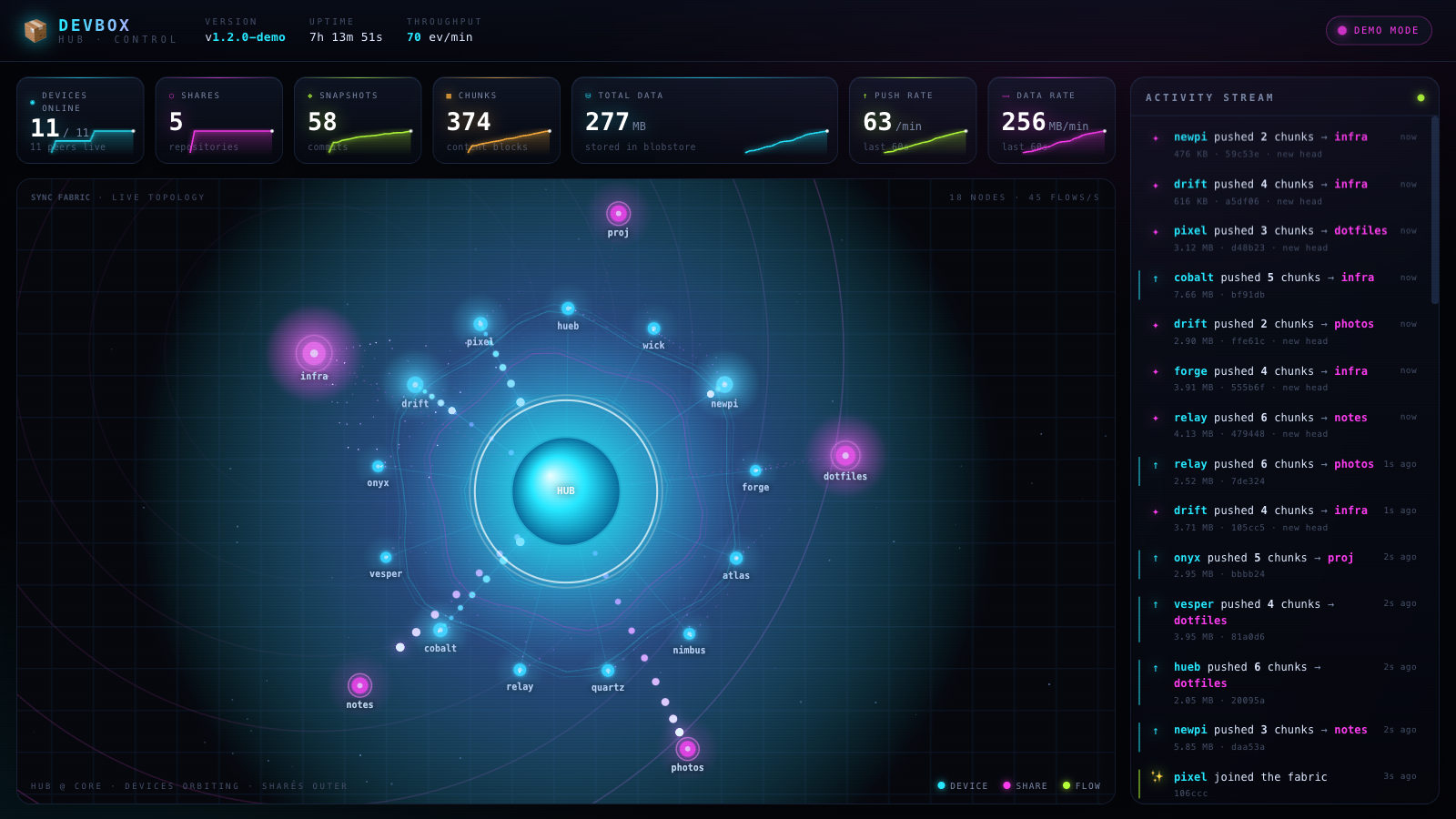
devbox-hub serve --dashboard                       # loopback http://127.0.0.1:8099 (safe default)
devbox-hub serve --dashboard --dashboard-addr 0.0.0.0:8099   # expose on the LAN (unauthenticated — warns you)
devbox-hub serve --dashboard --gc-every 24h        # also self-maintain (in-process GC) — each sweep animates
A mission-control flow visualization rendered on <canvas> at 60fps: a breathing hub core, your
devices orbiting (bright = active), shares on the outer ring — and the fabric comes alive with five
flow events: push (device → hub → share, fans out to subscribers), pull (a calm teal pulse inbound as a
device syncs), conflict (a red collision burst when a stale push is rejected), gc (an amber hub-wide sweep
- toast when garbage-collection runs), and
join. Plus live metric tiles and a server-side history sparkline (stacked push/pull/conflict/gc per minute, last hour) that survives a page reload, and a streaming, color-coded activity feed.
| How it works | |
|---|---|
| 🖥️ Served from the hub | single go:embed'd HTML, vanilla JS + canvas, zero CDN/build |
🔌 GET /api/state |
snapshot: hub, totals, devices, shares + a 60-minute history window (UI polls every 10s) |
📡 GET /api/events |
SSE live flow stream (join · push · pull · conflict · gc) — the dashboard animates each one |
| 🔒 Loopback by default | unauthenticated read-only metrics; bind non-loopback only deliberately (it warns) |
🎬 ?demo=1 |
synthesizes a live stream of all five event types — instant wow + works offline (file://) |
flowchart LR
    DEV["💻 device pushes"] -->|"POST /v1/push"| HUB["🛰️ hub"]
    HUB -->|"Emit(join/push)"| BRK["📡 SSE broker"]
    BRK -->|"/api/events"| UI["📊 dashboard canvas"]
    HUB -->|"/api/state"| UI
    UI -.->|"particle device→hub→share"| UI
    style HUB fill:#0b2b3a,stroke:#27e8ff,color:#fff
    style UI fill:#2a0b2b,stroke:#ff3df0,color:#fff
    style BRK fill:#1e5a2e,stroke:#b6ff3a,color:#fff
🪝 Hooks
Drop executable scripts in <mount>/.devbox/hooks/, named after the event. bash everywhere
(a .ps1 hook auto-runs via pwsh on Windows 🪟). pre-* non-zero exit aborts the step.
60s timeout — a hung hook is killed, never wedges the loop. ⏱️
| Hook | Fires | Abort? | Typical use |
|---|---|---|---|
pre-push |
before upload | ✅ | 🧹 lint/format, secret scan |
post-push |
after upload | ❌ | 📣 notify, log, tag a snapshot |
pre-pull |
before apply | ✅ | 🛑 stop a container / dev server |
post-pull |
after apply | ❌ | 📦 pnpm install, migrate, restart |
on-conflict |
conflict copy made | ❌ | 🔔 open a diff, ping you, log |
#!/usr/bin/env bash
# .devbox/hooks/post-pull  —  reinstall deps + restart only when needed
if grep -qE 'package\.json|pnpm-lock\.yaml' "$DEVBOX_CHANGED_FILES"; then
  pnpm install --frozen-lockfile
fi
docker compose restart app   # 🚀
🌱 Injected environment variables
DEVBOX_EVENT=post-pull
DEVBOX_MOUNT=/srv/project
DEVBOX_SHARE=projects
DEVBOX_HOST=pi-node-07
DEVBOX_CHANGED_FILES=/tmp/devbox-changes.txt   # newline-delimited
DEVBOX_SNAPSHOT=ab12cd34
DEVBOX_REMOTE=hub.shoemoney.ai
🙈 .devignore & Secret Guard
🙈 .devignore — gitignore syntax, shared at the share root
node_modules/      # 📦 the usual suspects
dist/  build/  .next/  target/
*.log  *.tmp  .DS_Store
!.env.example      # ❗ negate to force-include
Matched paths are invisible to sync in both directions. Change it → rescan; newly-ignored files are left on disk (never deleted), they just stop syncing.
🔐 Secret Guard — always on, independent of .devignore
Important
Your pitch is "won't leak your
.env" — so devbox enforces it. A built-in deny-list runs in the push path and hard-refuses to upload matched files even if.devignoreis misconfigured. Belt and suspenders. 🩲
Default-blocked: .env · .env.* (except .env.example) · *.pem · *.key · id_rsa* ·
*.p12 · *.pfx · secrets/ · *.kdbx · common cloud-cred files. Blocked files show up in
devbox status. Add your own via [secrets].extra_patterns in config.toml.
⚙️ config.toml — per-machine tunables
[transfer]
max_kbps  = 0     # blob transfer cap (KB/s); 0 = unlimited
compress  = false # 🌐 gzip blobs BOTH ways (upload + download) — turn on for devices syncing over a WAN link

[sync]
rescan_seconds  = 60    # watcher-fallback rescan cadence; raise on a huge tree, lower for snappier convergence
ignore_defaults = false # 🙈 also ignore common junk (node_modules, .git, target, dist, build, .venv, __pycache__, …)

[secrets]
extra_patterns = ["*.secret", "vault-*"] # additional secret-guard deny patterns
compressonly gzips a chunk when it actually shrinks (incompressible blobs go raw), and the hub hashes the decompressed bytes so dedup + integrity are untouched. 🗜️ The WAN path is also hardened with granular timeouts, automatic retry+backoff on transient blips, and parallel blob transfer — no flags, always on.
🕰️ Versioning & Deploy
gitGraph
    commit id: "S1 📸"
    commit id: "S2 📸"
    commit id: "S3 ✏️"
    commit id: "S4 🍓"
    commit id: "S5 🚀 deploy"
- 📸 Every accepted change = an immutable snapshot (BLAKE3 of the manifest). Manifests are themselves content-addressed → 100 pushes don't store the tree map 100×.
- ↩️
devbox restore <snap> [path]rolls back a file or whole share (itself a new change → reversible). - 🚀
devbox deploy <share> <snap>pins a mount to a snapshot by applying it without pushing a new head — history stays untouched and the daemon won't drag it back to latest ([pinned]). Blue/green deploys for your/var/wwwboxes, basically free; re-mount to resume live sync. - 🧹
devbox-hub gcsweeps unreferenced chunks (refcounted).
🖥️ Cross-Platform
| Capability | 🐧 Linux | 🍎 macOS | 🪟 Windows |
|---|---|---|---|
| File watching | inotify | FSEvents | ReadDirectoryChangesW |
| Atomic apply | rename(2) |
rename(2) |
ReplaceFile/MoveFileEx |
| Hooks | bash | bash | bash (git-bash/WSL) or .ps1→pwsh |
| Service | systemd | launchd | Windows Service |
| Static binary | ✅ | ✅ | ✅ |
🧭 Canonical paths are forward-slash + relative (converted at the Windows boundary). Filenames illegal/colliding on an OS (
foo.govsFoo.go,aux, trailing dot) → skip + warn + surface indevbox status; the hub keeps the bytes, peers that can hold the name still get the file. Never fatal. 🛟
🔐 Security & Durability
Threat model: single-owner, multi-device (every enrolled device is yours). Within that, v1 went through an adversarial audit — every data-loss and arbitrary-file path is closed. 🛡️
| Layer | Protection |
|---|---|
| 🪪 Device identity | ed25519 keypair per device; join requires proof-of-possession (a signed challenge — you can't claim a key you don't hold), and a bad request never burns the one-time token |
| 🎟️ Auth | bearer tokens, hashed at rest (hub stores no plaintext creds), device-revocable |
| 🧊 Content integrity | every chunk and manifest is re-verified against its BLAKE3 hash on download — a corrupt/truncated transfer or hostile hub can't write wrong bytes into your tree |
| 🚧 Path safety | hub rejects any blob key that isn't 64-hex (no ..%2f traversal → no arbitrary file read); the client refuses manifest paths that escape the mount root |
| 🔑 Secret guard | case-insensitive deny-list (.ENV == .env); .env/keys/*.env/.aws/credentials never leave the machine, independent of .devignore |
| 🛟 Never lose a byte | losing local edits become .conflict copies; ignored/guarded on-disk files are preserved before any hub overwrite; atomic writes are fsync'd (power-loss safe) |
| 🧹 Safe GC | mark-and-sweep from every live head — never frees a chunk a share still needs, even if refcounts are off |
| 🚪 DoS bounds | request-body caps (256 MiB blob / 8 MiB JSON → 413) + server read/idle timeouts |
| 🆔 Daemon | single-instance pidfile with a PID-reuse guard (start-time token) so stop never signals a stranger |
🔬 how the integrity + path guards chain
flowchart LR
    P["📥 pull"] --> G{"64-hex<br/>blob key?"}
    G -->|no| X1["🚫 404 — no traversal"]
    G -->|yes| F["⬇️ fetch blob"]
    F --> H{"BLAKE3<br/>matches key?"}
    H -->|no| X2["🚫 integrity fail"]
    H -->|yes| C{"path inside<br/>mount?"}
    C -->|no| X3["🚫 refuse escape"]
    C -->|yes| W["⚛️ atomic write + fsync"]
    style X1 fill:#5a1e1e,stroke:#ff6b6b,color:#fff
    style X2 fill:#5a1e1e,stroke:#ff6b6b,color:#fff
    style X3 fill:#5a1e1e,stroke:#ff6b6b,color:#fff
    style W fill:#1e5a2e,stroke:#51cf66,color:#fff
🗺️ Roadmap
🔮 Looking ahead: the full v2 design spec — multi-owner teams + ACLs, client-side E2E encryption (convergent, keeps dedup), LAN peer chunk-exchange + hub HA, 3-way merge, and a TUI — sequenced M8→M11 by dependency. M8 foundations are landing now; M9–M11 stay demand-driven (build E2E when an untrusted-hub user exists, P2P when the uplink hurts, the TUI when asked).
flowchart LR
    M6["M6 🕰️\nVersioning"] --> M65["M6.5 🚢\nDeploy"]
    M65 --> M7["M7 🛡️\nHardening\n+ M7.5/7.6 audit"]
    M7 --> M8["M8 🏗️\nv2 Foundations\nmigration · teams · control socket"]
    M8 --> M9["M9 🔐\nTrust + HA\nACL · E2E · S3"]
    M9 --> M10["M10 🤝\nCluster + merge\nP2P · resolver"]
    M10 --> M11["M11 ✨\nPolish\nTUI · power"]
    style M6 fill:#1e5a2e,stroke:#51cf66,color:#fff
    style M65 fill:#1e5a2e,stroke:#51cf66,color:#fff
    style M7 fill:#1e5a2e,stroke:#51cf66,color:#fff
    style M8 fill:#1e5a2e,stroke:#51cf66,color:#fff
    style M9 fill:#0d1117,stroke:#4F9CF9,color:#fff
    style M10 fill:#0d1117,stroke:#4F9CF9,color:#fff
    style M11 fill:#0d1117,stroke:#4F9CF9,color:#fff
| Milestone | Deliverable | |
|---|---|---|
| ✅ | M0 — Skeleton 🦴 | cobra CLI, devbox join, keypair, machine config |
| ✅ | M1 — Watch + secrets 👀 | fsnotify, .devignore, secret-guard, FastCDC+BLAKE3 chunking, content-addressed manifests |
| ✅ | M2 — Hub + push 🛰️ | shares, join tokens, CAS, publish, HTTP upload, snapshots, bearer auth, /metrics — deployed on .10, verified cross-machine |
| ✅ | M3 — Two-way sync 🔄 | SSE event fan-out, mount, pull + atomic apply, per-file 3-way conflict copies, live start daemon — two Macs sync live through the hub |
| ✅ | M4 — Read-only + bw 🔒 | server-enforced read-only bit, sub-path mounts (mount proj/app /dir), bandwidth cap — fleet-verified |
| ✅ | M5 — Hooks 🪝 | bash (+.ps1) lifecycle runner, env injection, 60s timeout, pre-* veto — post-pull fired on a fleet node |
| ✅ | M6 — Versioning 🕰️ | devbox log (full snapshot ids) / restore (revert any file) / hub gc — fleet-verified |
| ✅ | M6.5 — Deploy 🚀 | devbox deploy <share> <snapshot> — apply a snapshot without pushing, [pinned] mount; fleet-verified blue/green |
| ✅ | M7 — Hardening 🛡️ | devbox doctor, stop/pidfile, hook edit/list, SSE backoff+jitter, 60s rescan fallback (survives dead/limited inotify watchers — PRD risk #1), share-name guard, release builds — fleet-verified |
| ✅ | M7.5 — Audit hardening 🔐 | adversarial security/data-loss audit + fixes: blob-hash path-traversal blocked, download blob-integrity check, manifest-path containment, secret-guard case-insensitive + more patterns, never-clobber ignored/guarded files, GC made safe vs cross-share refcount undercount — all with regression tests, race-clean, fleet-verified |
| ✅ | M7.6 — Hardening complete 🛡️ | 💽 fsync durability on atomic writes (power-loss safe), 🚪 request size caps + server timeouts (DoS), 🆔 pidfile PID-reuse guard (start-time token), 🪪 join proof-of-possession (ed25519 signature, token not burned on a bad request) — fanned out to parallel worktree agents, regression-tested, race-clean, fleet-verified |
| ✅ | M8 — v2 Foundations 🏗️ | 🔑 schema migration runner (PRAGMA user_version, transactional, VACUUM INTO backup, refuses a newer DB) · 🔢 per-(share,id) snapshots (fixes the cross-share refcount undercount; GC + head-backfill reworked) · 🎛️ daemon control socket (Unix socket, HTTP/1.1, 0600) wiring devbox pause/resume + live-socket-aware status · 👥 M8a: principals + per-share roles + write enforcement (devbox-hub member/principal; legacy shares = v1, first grant flips to deny-by-default; role≥editor AND the writable clamp). Both migrations verified on a copy of the real .10 hub DB (counts preserved, 3 legacy heads repaired, chains 0→1→2). 👀 read side (GET /v1/members + devbox members) · ✉️ device-facing invites (POST /v1/invite + devbox invite, privilege attenuation via pure meta.MayGrant, self-seed on the legacy→explicit flip) — cross-machine fleet-verified on arm64 Pis · 🛟 restore preserves uncommitted edits (never-lose-a-byte on revert). M8's justified-now scope is complete — the conflict sidecar moves to M10 (only its resolver consumes it) and read-side ACL gating is M9 |
🔮 still ahead in M8 / genuinely v2
Landed in M8 above: the migration runner, per-(share,id) snapshots, and the control socket. Still sequenced ahead:
- 📝 Conflict-copy on explicit
restore/deploy(M8-3) — needs base/ancestor awareness so it preserves only uncommitted edits without breaking restore-reproduces-snapshot; rides the conflict sidecar. - 👥 Principals / roles / invites + write enforcement (M8a) — the membership layer E2E + P2P both need underneath them.
- 🔑 Read-side ACL + deny-by-default writes (M9) — only meaningful once shares span multiple owners; the genuinely new attack surface, staged after write-side.
- 🔢
snapshot_chunksedge table (M9) — a derived-refcount source for E2E/P2P; deferred until a consumer exists (the migration runner makes adding it a one-liner).
🔮 v2 backlog
- 🤝 LAN peer chunk-exchange — co-located nodes swap chunks directly (Syncthing-style)
- 🎛️ Interactive conflict resolver — diff + keep-mine/theirs/both/edit
- 🔁 Re-share / delegation (the
spermission) - 🧬 Content-level 3-way text merge
- 🔋 Laptop power sanity — pause-on-metered / pause-on-battery / sync windows
- 🔏 Client-side E2E chunk encryption
- 🏰 Hub clustering / HA
- 🖼️ Full TUI dashboard
⚖️ License & Open-Core
📜 AGPLv3 core — self-host free, forever. · 💼 Commercial license for the hosted tier.
devbox is open-core: the entire hub + clients in this repo are AGPLv3 and fully
self-hostable. A future hosted version (signup, billing, provisioning) is a separate, closed
control plane that wraps the same single-tenant hub — designed for via clean seams (BlobStore
interface, config-driven limits, /metrics) but not part of this OSS repo.
Offering devbox as a hosted service? AGPLv3 means open your changes — or grab a commercial license. 🤝
🙌 Contributing
✅ v1 is feature-complete — the spec documents the full design, and
scripts/build-release.shcross-compiles every platform.
- 🍴 Fork & branch
- 🧪 Keep it lazy-correct (smallest diff that works, tests for non-trivial logic)
- 📝 Update the docs in the same PR — they get the full flare treatment 😎
- 🚀 Open a PR
Made with 📦, ☕, and a healthy fear of rm -rf on the wrong machine.
“It's like Dropbox, but it actually respects that you're a developer.” 💙